Vietnam’s handwoven (or wicker) homeware industry—centered around products crafted from natural materials like rattan, seagrass, and water hyacinth—is a thriving sector with global reach and deep local roots. With a long tradition of craftsmanship and a strong natural resource base, Vietnam has grown into one of the world’s top three exporters of natural-fiber (or colloquially known as “wicker”) homeware, supplying an estimated $350 million worth of goods annually to international markets.
Vietnamese artisans produce a wide range of products including storage baskets, hampers, bins, boxes, trays, rugs, mats (and similar tabletops), furniture, lampshades, and planters, much of which is exported to high-demand markets such as the United States (accounting for 35–40% of exports), the European Union (30–35%), Japan, South Korea, and Australia. These products are appreciated not only for their functionality and beauty, but also for their sustainability—made almost entirely from fast-growing, renewable plants.
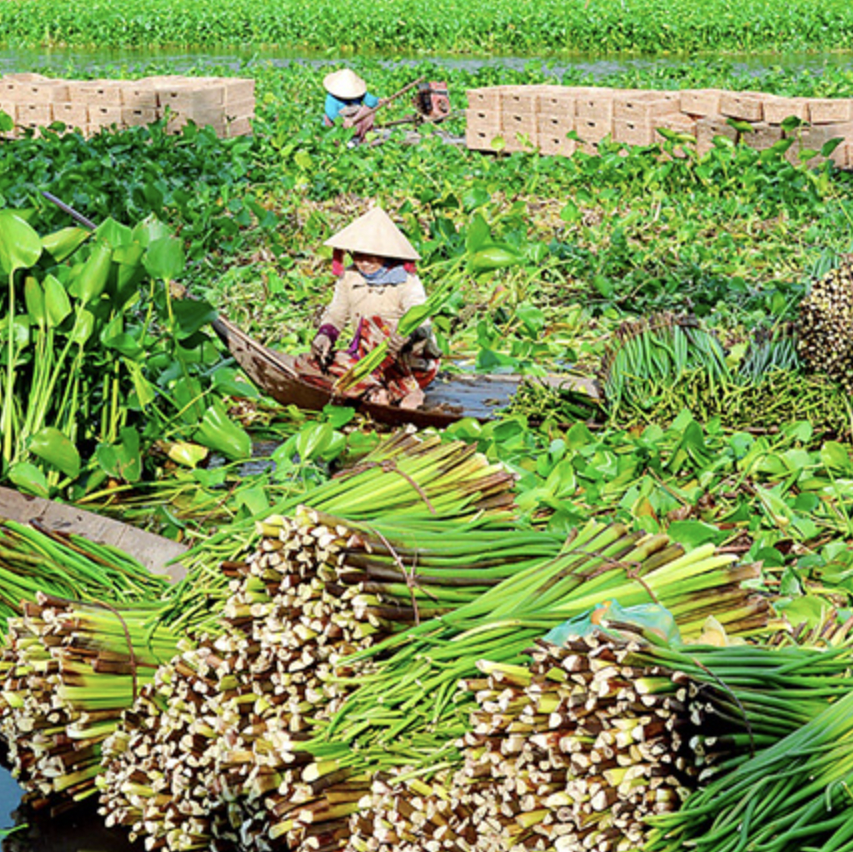
The raw materials used in this industry are both locally sourced and highly renewable. Seagrass, which grows in shallow coastal waters, is harvested mainly in Thanh Hóa and Ninh Bình provinces, which together supply more than 60% of Vietnam’s total seagrass output. Meanwhile, water hyacinth, a fast-growing aquatic plant found widely in the Mekong Delta, is harvested from provinces such as Đồng Tháp and An Giang, where it is both a craft material and a means of controlling waterway overgrowth. Rattan, used for its strength and flexibility in furniture and décor, is mostly collected from the central and northern forests. Collectively, Vietnam produces hundreds of thousands of tons of these natural fibers annually, ensuring a stable supply for domestic manufacturers and exporters.
A key feature of the industry is its strong connection to rural employment and traditional village economies. There are over 300 officially recognized craft villages specializing in weaving with these materials, supporting an estimated 400,000–500,000 rural workers, the majority of whom are women. The flexible nature of home-based or village-based production provides valuable income to communities where agricultural work alone may be insufficient. Government programs such as the One Commune, One Product (OCOP) initiative have further boosted local craft producers by linking them with national and export markets, and encouraging improved product quality and branding.
As global consumers become more environmentally conscious, demand for eco-friendly, handmade, and biodegradable products is growing rapidly. Vietnam’s homeware exporters have increasingly aligned their production with international sustainability standards, including BSCI (social compliance), REACH (chemical safety), and FSC (responsible forestry). Many producers also offer certified organic or chemical-free finishes, which are especially popular in the European Union. As a result, Vietnam has become a favored sourcing hub for large retailers, importers, and home decor brands seeking sustainable supply chains.
The industry benefits from broader global design trends as well. Styles like Japandi, boho-chic, wabi-sabi, and rustic modern—all of which value natural textures, earthy tones, and artisanal craftsmanship—have helped drive up demand for Vietnam’s woven homeware. Lightweight, foldable, and aesthetically versatile, these products are also ideal for urban living and online retail.
However, the sector does face challenges. Inconsistencies in product quality, limited innovation in design compared to competitors like the Philippines or Indonesia, and weak international branding of Vietnamese companies are ongoing issues. Additi
However, the sector does face challenges. Inconsistencies in product quality, limited innovation in design compared to competitors like the Philippines or Indonesia, and weak international branding of Vietnamese companies are ongoing issues. Additionally, the environmental impact of overharvesting and local water pollution—particularly in areas where seagrass or water hyacinth are gathered—has raised concerns about the long-term sustainability of raw material supply. Moreover, the bulk of the industry still operates on an OEM basis, producing goods under foreign labels, which limits value capture and brand recognition for Vietnamese producers. Despite these hurdles, Vietnam’s handwoven homeware industry holds strong potential. By combining natural fibers with modern materials such as iron, wood, and fabric, and investing in original design and eco-labeling, producers are expanding into new market segments. E-commerce has also unlocked opportunities: platforms like Alibaba, Etsy, and Amazon Handmade now feature hundreds of Vietnamese-made products, allowing even small cooperatives to access global buyers directly. With growing support from local government and trade associations, as well as sustained consumer interest in sustainable living, Vietnam is well-positioned to further solidify its role as a global leader in natural-fiber homeware.